Palazzo Gondi · 17 February 2015
Leonardo da Vinci’s Annunciation passes through the Gondi household
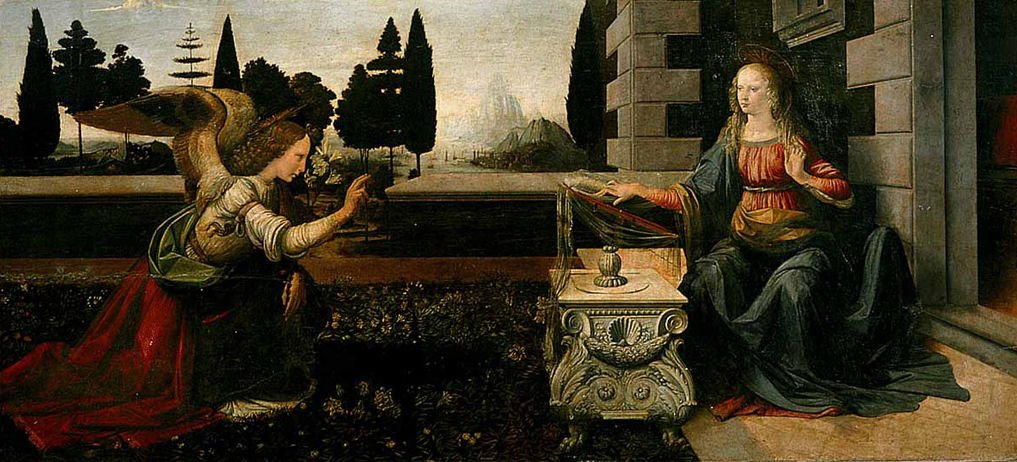
At the Accademia Toscana di Scienze e Lettere La Colombaria, a lecture was given by Prof. Riccardo Fubini and Dr. Massimo Giontella. The lecture put forward new hypotheses on the Annunciation by Leonardo da Vinci, the painting now held at the Uffizi in Florence.
On this occasion a preview of their conclusions was given, with a fuller account reserved for a forthcoming publication. The landscape in the background is Otranto, as demonstrated by the geographical resemblances and by a letter from Federico da Montefeltro, Duke of Urbino, who states that he has before him the plan of the city commissioned by Sixtus IV in view of an attack to liberate it from the Turkish assault. The painting can therefore be dated to 1481.
If Federico had the plan of Otranto in his hands, it is clear that the Florentine villa depicted in the painting is his own Villa di Rusciano in Florence. Federico’s involvement with the painting rules out Leonardo as its principal author, since there were never any dealings between the Duke and the artist. Alongside these arguments there is one of a stylistic nature: the obsessive study of detail is irreconcilable with Leonardo’s manner. Leonardo is unquestionably present in the painting as an emancipated pupil, but the principal artist is Antonio del Pollaiolo, contrary to the official attribution. The painting was an exhortation to Federico to take command of military operations against the Turks. The true patron was therefore Giuliano Gondi, plenipotentiary in Florence for the Duke of Urbino, urged on by the Neapolitan royal family to whom Giuliano Gondi was closely bound.
The mountain in the background, which had anthropomorphic features before the restoration of 2000, represented the Sibyl foretelling Federico’s victory: none of which came to pass, because Sixtus IV, fearing that Federico would definitively embrace the Neapolitan cause, halted the Duke of Urbino when he had already set out for Otranto and had reached Recanati. Villa di Rusciano was purchased by Giuliano Gondi, as attested by a coat of arms still preserved in the villa, the Gondi arms surmounted by an eagle. Almost certainly, then, the Annunciation followed the Gondi to their palace in the city.